1
Understanding the Requirement
The organisation identifies the workforce gap, the reason it exists and the result the additional capability should support.
Helping UK Organisations Plan, Coordinate and Improve Workforce Recruitment
Recruitment becomes harder to manage when departments, sites and hiring managers are on different paths. While they are part of the same workforce picture, permanent vacancies, temporary cover, contract appointments and senior appointments can all be handled separately.
Axiom Arise provides workforce management solutions to organisations that want more visibility and consistency in their recurring recruiting needs. Our personalised approach supports employers to understand what capability they require, when, and which recruitment route is appropriate.
We build a better structure without thinking of people as numbers on a workforce plan.
People-first partnership
Recruitment with purpose
The approach
The search phrase “What Is Workforce Solutions?” generally refers to services that help an organisation plan, recruit, coordinate and review the people it needs across different employment and engagement models. This may include permanent, temporary, contract and senior recruitment alongside demand planning, supplier coordination, governance and reporting.
Workforce management services are broader than filling one vacancy. They consider how requirements connect and how responsibilities are shared across HR, procurement, operations, hiring managers and recruitment partners. The right workforce management solutions should reflect the organisation’s size, structure, workforce plans and internal capability. They do not need to involve fully outsourcing the recruitment function.
A series of vacancies can sometimes reveal a wider problem. Departments can continue recruiting for the same skills, and sites can use different suppliers. Managers might receive contradictory market information, recruitment spending can be hard to interpret, and urgent requests can repeatedly interrupt planned work.
These are classic workforce solution challenges. They may be a symptom of the fact that the recruitment activity has outgrown the structure created to manage it. Our workforce management solutions help employers to look beyond the vacancy and identify where fuzzy ownership, duplicated work or disconnected decisions may be creating unneeded pressure.
A workforce review should start with what is already happening. Current vacancies, repeat roles, locations, suppliers, approval routes and hard-to-source skills would be useful information. Other factors that may be relevant are seasonal demand, contractor end dates, growth plans and existing responsibilities.
The aim is to identify missing information, duplicated activity and demand that could be foreseen earlier. Our workforce recruitment solutions are driven by evidence from the organisation, not assumptions about how it should recruit.
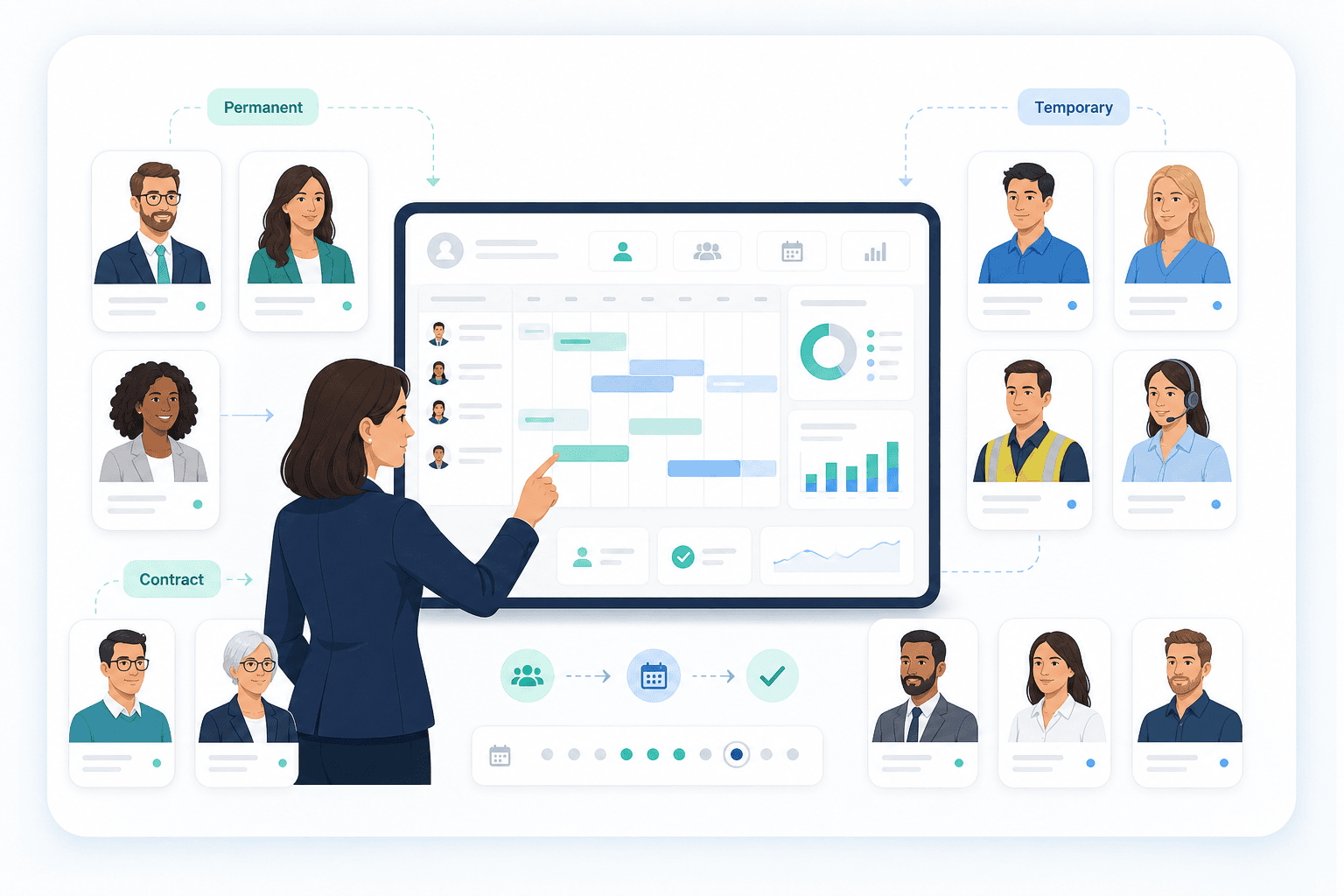
The workforce's different needs should be met in different ways. An ongoing role may need a permanent employee. Temporary staffing may be more appropriate to support a short period of operational pressure. For a particular project, a contractor might be the right fit, but a confidential leadership role might require executive search. Permanent workforce solutions can assist in building long-term capability but should not be used automatically where duration or future workload is uncertain.
An employer searching for an executive search may have a senior appointment in mind, but this should still be considered within the wider leadership and workforce plan. Effective workforce management solutions enable decision-makers to consider the work, time frame, skills required and employment model before they decide on a recruitment approach.
Clear governance should make recruitment easier to manage, not add unnecessary layers. The organisation should know who approves vacancies, owns briefs, authorises salaries or rates, receives updates and makes final hiring decisions.
HR, procurement, operations, hiring managers and recruitment partners each need clearly defined responsibilities. Managed Workforce Solutions work best when these boundaries are agreed upon in practical language and communicated to everyone involved.
Unexpected requirements will always arise, but many workforce needs can be seen in advance. Growth plans, seasonal trading, turnover, project dates and contract end points can indicate future demand. Succession and organisational change may also affect required skills.
Forecasting creates time to review role information, assess the market and prepare recruitment channels before demand becomes urgent. Our Workforce Management Solutions help employers use visible business information to make earlier, more considered decisions while retaining flexibility when circumstances change.
A Clear Recruitment Process
A joined-up framework should connect business need, recruitment activity and workforce outcomes.
The organisation identifies the workforce gap, the reason it exists and the result the additional capability should support.
Budget, timing and the appropriate route are confirmed before the market is approached.
Internal resources, recruitment suppliers and relevant channels are agreed for the requirement.
Briefs, communication standards, decision points and feedback expectations are made consistent.
Relevant information is transferred into HR, payroll, operations or project teams according to the engagement model.
Activity, recurring difficulties and future demand are reviewed.
Evidence and stakeholder feedback are used to refine the approach.
Several suppliers can provide useful expertise across locations, sectors and employment models. Problems arise when suppliers receive conflicting briefs, approach the same people or work without clear vacancy ownership. Duplication and inconsistent communication can then affect everyone involved.
A workforce recruitment agency can support agreed allocation, communication standards and review arrangements. A workforce employment agency may also help coordinate different forms of workforce supply, depending on its actual workforce employment agency activities. The goal should be useful supplier relationships, not reducing the number of partners for its own sake.
Reporting has value only when it helps the organisation make better decisions. Depending on the agreed service, employers may review open requirements, vacancy age, interview activity, supplier usage, contractor end dates and recurring shortages.
The figures should prompt practical questions about recurring vacancies, slow approvals, unsuitable search routes and departments needing more support. Reporting should not reduce people to dashboard entries. It should create a clearer view of the recruitment experience and the decisions affecting it.
Many hiring managers recruit only occasionally while managing wider operational priorities. A coordinated approach can provide clear briefs, approval routes, market guidance, interview responsibilities and a named contact.
The purpose is not to remove managers from recruitment. Their understanding of the role and team remains important. The aim is to give them a process that is easier to follow and information that supports a confident decision.
A workforce model should improve individual experiences rather than make recruitment feel impersonal. Candidates need accurate information and respectful communication. Temporary workers need practical assignment details, contractors need clarity about deliverables, and senior candidates may require confidentiality.
Consistent workforce-employment solutions should also prevent people from receiving duplicated approaches from several suppliers or being passed between teams without explanation.
Axiom Arise combines coordination with personal communication because stronger processes still depend on relationships, trust, and understanding people properly.
The right service model depends on recruitment volume, internal resources, and the amount of coordination required. An advisory review can identify practical improvements. Coordinated support can bring hiring categories under agreed processes, while preferred-partner or multi-supplier models can define ownership and allocation.
Total Workforce Solutions may bring permanent, temporary, contract and senior recruitment into a wider framework. However, this term should not be used to imply technology, payroll, legal responsibility or complete outsourcing unless those services are genuinely included.
Service boundaries and commercial responsibilities should always be agreed before implementation.
Recruitment is one response to a capability gap, but it is not the only one. An organisation may develop employees, redesign responsibilities, redeploy skills or plan succession. Temporary or contract support may also suit some needs better than permanent recruitment.
A workforce development agency may focus primarily on training, employability or skills development. A recruitment partner generally supports access to people from the external labour market. A practical workforce plan considers internal development and external recruitment together rather than treating them as competing options.
UK workforce planning should take account of regional salary and pay-rate expectations, candidate availability, commuting patterns and hybrid or on-site requirements. Different recruitment routes involve different responsibilities. Employers should consider right-to-work checks, contracts, temporary worker arrangements, contractor engagement, data protection and health and safety. Professional advice may be required for legal or tax questions.
A workforce recruitment agency UK employers choose should understand how notice periods, local labour markets and sector requirements affect workforce availability. The purpose is not to turn workforce planning into legal guidance. It is to make sure practical UK considerations are recognised before recruitment activity begins.
A workforce model should not remain unchanged simply because it has been documented. Reviews can examine outcomes, hiring-manager experience, supplier communication, difficult roles, costs and changing priorities. Candidate and worker feedback may expose weak communication or handovers.
Our Workforce Management Solutions use these conversations to identify what is working, what has become unnecessarily difficult, and where the service should adapt. Continuous improvement should make recruitment clearer and more responsive while preserving the personal relationships that influence trust, engagement, and successful appointments.
A good partner should understand the wider workforce plan and not just the vacancy in front of them. Employers should ask about the supported recruitment categories, the available reporting, how suppliers are handled, and what the internal responsibilities are.
For businesses looking for the best permanent recruitment companies in the UK, permanent hiring outcomes may be the first place to begin. The workforce requirement should also be broadened to include temporary, contract, executive and internal capability needs. A relationship-led partner should be giving proportionate support, not forcing a complex model that the organisation doesn’t need.
Tell us how your organisation currently recruits, where demand is recurring and which workforce issues are becoming difficult to manage. We will help you review the position and consider a practical, proportionate approach that supports your people and business priorities.
FAQs